Amazon Unveils AI-Powered Merchandise Design Feature, Intensifying Competition in the Print-on-Demand Market

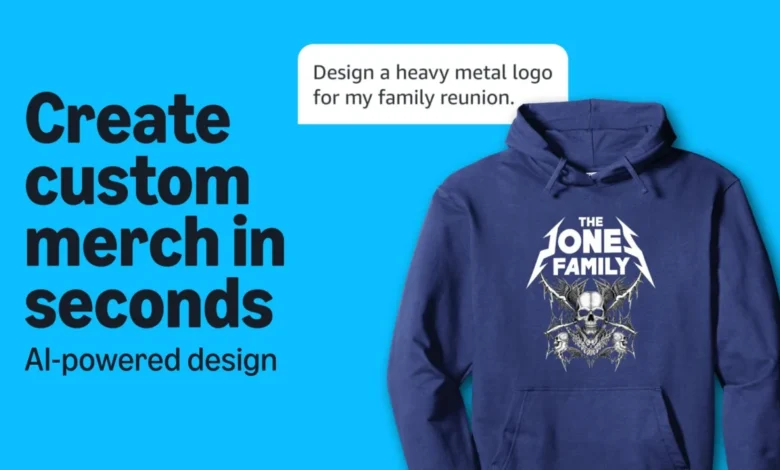
Amazon has officially launched a groundbreaking new feature enabling consumers to design custom merchandise using artificial intelligence directly through its Shopping app. This strategic move, announced on Monday, significantly expands Amazon’s footprint in the burgeoning print-on-demand (POD) sector, presenting an immediate and formidable challenge to established online platforms such as Redbubble, Bonfire, Spring, Fourthwall, and a host of independent creators. The e-commerce giant revealed that users can now leverage AI prompts via the Alexa feature within its proprietary Shopping app to conceive and create unique product designs. This integration allows any individual to transform a conceptual idea into a tangible design, which can then be emblazoned on a wide array of items, from various apparel categories to tumblers and water bottles, all facilitated by Amazon’s robust print-on-demand service, Merch on Demand.
This innovative offering is poised to democratize the design process, making custom product creation accessible to a broader audience who may lack traditional graphic design skills or access to sophisticated software. Amazon positions the service as ideal for crafting unique, one-off items—such as bespoke T-shirts for a family reunion, a deeply personalized gift, or merchandise featuring a beloved pet’s portrait. The convenience is further amplified by Amazon’s comprehensive fulfillment capabilities; after a design is generated and approved by the user, the company assumes responsibility for the entire production and delivery process, leveraging its expedited Prime shipping infrastructure. While this feature opens new avenues for consumer creativity and personalized commerce, it simultaneously reignites critical discussions within the artistic community regarding the ethical implications of AI models trained on existing human-created artwork.
Democratizing Design: Amazon’s Latest AI Integration
The core of Amazon’s new initiative lies in its intuitive integration of generative AI with its existing Merch on Demand service. By tapping the Alexa icon, typically located in the bottom right corner of the Amazon Shopping app, or by searching for "customize" in the search bar and selecting the corresponding drop-down option, users are ushered into a dedicated design interface. Within this environment, a simple textual description or "prompt" to Alexa can initiate the AI’s creative process. The AI then generates design options based on the user’s input, which can subsequently be refined and edited. Users have the flexibility to modify designs through suggested actions or by typing further instructions, allowing for iterative improvements until the desired aesthetic is achieved. Once satisfied, these personalized product designs can be shared with friends and family, enabling collaborative shopping experiences where multiple individuals can add the custom item to their respective Amazon shopping carts.
This functionality effectively transforms the traditionally complex and skill-intensive process of graphic design into a user-friendly conversational experience. The extensive list of supported merchandise underscores Amazon’s ambition to cater to a broad spectrum of personalization needs. This includes a variety of apparel such as T-shirts, V-necks, long-sleeve shirts, polo shirts, quarter zips, jerseys, hoodies, sweatshirts, tank tops, and raglans. Beyond clothing, the service extends to accessories like tumblers and water bottles, broadening the appeal for everyday personalized items. Crucially, the feature is currently available exclusively in the U.S. market and is free to use, with customers only incurring costs for the physical products they choose to purchase. This "pay-per-product" model aligns with the typical print-on-demand structure, minimizing upfront commitment for users.
The Evolving Landscape of Print-on-Demand
The print-on-demand (POD) industry has witnessed explosive growth over the past decade, transforming from a niche service into a multi-billion-dollar global market. Valued at approximately $6.19 billion in 2023, the market is projected to expand significantly, reaching an estimated $38.3 billion by 2032, according to various industry reports. This growth is driven by several factors: the rise of the creator economy, the increasing demand for personalized products, minimal upfront investment for sellers, and advancements in digital printing technology. Platforms like Redbubble, which boasts millions of unique designs, and Bonfire, known for its fundraising-focused campaigns, have cultivated vibrant communities of independent artists and organizations. Similarly, Spring (formerly Teespring), Zazzle, and Society6 offer creators avenues to monetize their designs without the complexities of inventory management, manufacturing, or shipping. Etsy, while not solely a POD platform, hosts a significant number of shops utilizing POD services for custom goods.
Amazon itself is no stranger to this market. Its "Merch by Amazon" program, launched in 2015, was an early foray into print-on-demand, primarily catering to content creators, developers, and brands looking to sell custom apparel. This service, later rebranded and expanded as "Merch on Demand," allowed approved sellers to upload designs, select product types, and set prices, with Amazon handling the production, inventory, shipping, and customer service. The new AI-powered design feature represents a significant evolution of this existing infrastructure, shifting the primary design input from human creators to artificial intelligence, and broadening the user base from dedicated sellers to everyday consumers. By directly embedding AI design capabilities into its main Shopping app, Amazon is not merely offering another POD service; it is integrating personalized product creation into the core consumer shopping journey, a move that could fundamentally redefine how consumers interact with custom merchandise.
A Brief History of Generative AI in Creativity
The integration of generative AI into consumer-facing design tools marks a pivotal moment in the ongoing technological revolution. The journey of generative AI, particularly in the realm of visual arts and design, has been rapid and impactful. Key milestones include the emergence of sophisticated text-to-image models such as OpenAI’s DALL-E in 2021, followed by DALL-E 2 in 2022, and the widespread adoption of Stable Diffusion and Midjourney in the same year. These models, trained on vast datasets of images and corresponding text descriptions, demonstrated an unprecedented ability to generate novel, high-quality images from simple text prompts. This technological leap captured the public imagination, showcasing the potential for AI to act as a creative assistant or even an autonomous artist.
Amazon has been a significant player in the broader AI landscape for years, primarily through its voice assistant Alexa and its robust Amazon Web Services (AWS) AI offerings, which provide machine learning infrastructure and tools to developers and enterprises worldwide. The company’s deep investment in AI research and development spans various domains, from recommendation engines and logistics optimization to natural language processing and computer vision. The current integration of AI design into the Shopping app is a natural extension of Amazon’s overarching AI strategy: to leverage cutting-edge artificial intelligence to enhance customer experience, streamline operations, and open new avenues for commerce. This latest feature not only showcases Amazon’s technical prowess but also its commitment to bringing advanced AI capabilities directly into the hands of its vast consumer base, turning complex AI models into accessible tools for everyday personalization.
Competitive Landscape and Industry Reactions
Amazon’s entry into AI-powered merchandise design significantly intensifies the competitive pressure on existing print-on-demand platforms. Companies like Redbubble, known for its expansive artist community and unique designs, or Bonfire, which emphasizes ethical production and community fundraising, built their businesses on empowering human creators. Amazon’s new offering, by contrast, targets the average consumer, enabling them to bypass traditional design skills entirely. While these incumbent platforms have increasingly explored AI tools for their creators (e.g., AI-powered mockups, design assistants), few have integrated a direct, consumer-facing AI design engine into their core shopping experience with the same scale and seamlessness as Amazon.
Logically inferred reactions from competitors would likely focus on differentiating their services. They might emphasize their curated artist communities, commitment to supporting independent creators, higher royalty rates for human designers, or unique niche markets. For instance, a representative from a platform like Redbubble might highlight their dedication to "authenticity and supporting human creativity," while also acknowledging the inevitability of technological advancement. Other platforms might look to integrate similar AI tools for their own users, albeit perhaps with a stronger emphasis on ethical AI sourcing or giving creators more control over how AI assists their artistic process rather than replacing it. The challenge for these platforms will be to maintain their appeal to human artists and discerning consumers who value original, human-generated art, while also exploring how to adapt to a market increasingly shaped by AI-driven personalization. The sheer scale of Amazon’s user base and the power of Prime shipping create a formidable competitive advantage that cannot be understated.
The Ethical Canvas: AI, Art, and Intellectual Property
The launch of Amazon’s AI design feature, while innovative, immediately raises profound ethical and legal questions, particularly concerning intellectual property and the future of human artistry. The original article briefly touches upon the potential disquiet among "artists whose work has been used to train AI models," and this sentiment represents a significant and ongoing debate within the creative industries. Generative AI models are typically trained on vast datasets comprising billions of images, many of which are scraped from the internet without the explicit consent or compensation of the original creators. Artists and photographers argue that this constitutes unauthorized use of their work, devaluing human creativity and potentially infringing on their copyrights. Lawsuits have already been filed against AI companies by groups of artists and stock photo agencies, alleging copyright infringement and unfair competition.
The implications for Amazon’s service are multifaceted. While Amazon states users can create designs, the underlying AI model’s training data remains a black box to the end-user. This raises questions about who bears responsibility if an AI-generated design inadvertently infringes on an existing copyright. Will Amazon implement robust filtering mechanisms to prevent the creation of designs that too closely mimic copyrighted material or specific artistic styles? What recourse will original artists have if their unique aesthetic or specific elements of their work are replicated by an AI through a consumer prompt? These are complex legal and ethical quandaries that the industry is still grappling with. The U.S. Copyright Office has, to date, taken a cautious stance, generally stating that works created solely by AI are not eligible for copyright protection, implying that human authorship is a prerequisite. This further complicates ownership and liability for AI-generated merchandise. Amazon will likely need to navigate these issues carefully, potentially by establishing clear terms of service, robust moderation policies, and possibly offering tools for artists to opt out of having their work used for AI training, if feasible.
Amazon’s Strategic Play: Ecosystem Integration and Market Expansion
Amazon’s latest move is far more than just a new feature; it is a strategic maneuver that reinforces its dominance in e-commerce and deepens the integration within its vast ecosystem. By embedding AI-powered design directly into the Alexa interface within the Shopping app, Amazon leverages its existing technological infrastructure and massive user base. Alexa, a ubiquitous voice assistant in millions of homes, becomes a creative partner, seamlessly bridging the gap between verbal ideas and tangible products. This further entrenches customers within the Amazon ecosystem, encouraging greater engagement with its services.
The strategy also capitalizes on Amazon’s unparalleled logistics and distribution network, particularly its Prime shipping service. The promise of rapid delivery for custom-designed items eliminates a major friction point often associated with personalized products, which typically have longer lead times. This competitive advantage is significant, making instant gratification for custom goods a reality. Furthermore, this initiative taps into the "long tail" phenomenon in e-commerce, enabling the creation and sale of highly niche, personalized products that would otherwise be uneconomical to produce through traditional manufacturing. From obscure fandom merchandise to hyper-specific inside jokes on a T-shirt, the AI design tool caters to an infinite array of individual preferences, expanding Amazon’s product catalog in an unprecedented way without requiring inventory. This move strengthens Amazon’s position not only as a retailer but also as a platform provider, empowering consumers to become creators, albeit with AI assistance. The data generated from these design prompts and purchases will also undoubtedly feed back into Amazon’s powerful recommendation engines and market insights, further refining its understanding of consumer desires.
Operational Mechanics and User Experience
The operational efficiency and user-centric design of Amazon’s new feature are central to its potential success. The step-by-step process, initiated either through the Alexa icon or a "customize" search, guides users through a remarkably intuitive journey. This low-friction entry point is crucial for widespread adoption among a general consumer base that may not be tech-savvy in advanced design software. The ability to articulate an idea conversationally to Alexa and immediately visualize a generated design provides instant feedback and a sense of creative empowerment.
The iterative editing process, allowing users to refine designs with further prompts or suggested actions, ensures that the final product aligns closely with their vision. The sharing functionality further enhances the social aspect of personalized gifting or group apparel orders, simplifying coordination and collective purchasing. Behind this seamless front-end experience, Amazon’s robust backend infrastructure handles the complex logistics. This includes managing the AI model for design generation, routing orders to its Merch on Demand manufacturing facilities, overseeing the printing and production quality, and finally, dispatching items through its sophisticated fulfillment network. This end-to-end management, from concept to delivery, significantly lowers the barrier for consumers, transforming what was once a multi-step, often intimidating process into a streamlined, integrated shopping experience.
The Road Ahead: Future Implications and Outlook
Amazon’s venture into AI-powered merchandise design signals a transformative shift in the retail landscape, with profound implications for personalized commerce, the creator economy, and the broader application of artificial intelligence. Looking ahead, several developments are likely. We can anticipate an expansion of product categories beyond apparel and drinkware, potentially including home goods, accessories, and even more complex customizable items. The AI models themselves will undoubtedly become more sophisticated, offering greater stylistic control, more nuanced interpretation of prompts, and potentially even multi-modal input (e.g., uploading an image and describing desired modifications). International expansion beyond the U.S. market is a near certainty, as Amazon seeks to replicate the success of this feature globally.
For the creator economy, this development presents both challenges and opportunities. While some artists may view it as a threat to their livelihood, others might embrace AI as a powerful tool to accelerate their own creative processes, generate new ideas, or quickly prototype designs. The increased visibility and accessibility of custom merchandise through Amazon could also spur greater demand for truly unique, human-crafted designs that stand apart from AI-generated options. Ultimately, Amazon’s AI design feature is more than just a novel tool; it represents a significant step towards a future where personalized products are not niche items but an integrated, expected component of the everyday shopping experience, powered by the ever-advancing capabilities of artificial intelligence. The long-term impact will depend on how Amazon addresses the ethical and legal complexities, how competitors adapt, and how consumers and creators navigate this brave new world of algorithmic artistry.